
Freehold: a property game for a whole evening on one screen
Freehold is the long game in the catalog. Two to eight people roll two dice, move a token around a 40-space board, buy what they land on, and try to be the last solvent player. The television shows the board, the tokens, and the log. Each phone holds the private part: your cash, your deeds, a bid, or a trade offer. It is built for a night when the group has already joined a room once and is willing to stay.
Freehold is an independent game written for CastPlayTV by its creator. It is not Monopoly, and it is not affiliated with, endorsed by, or sponsored by Hasbro. The board follows a familiar property-trading pattern — color groups, railroads, utilities, tax spaces, and two card decks — so people who have played that kind of game can sit down without a rules lecture. The name on this page is Freehold.
2–8 players
How to play
1Everyone starts with cash
Two to eight players start with $1,500.
Passing Go pays $200.
The last person who is not broke wins.
2Roll, and watch the doubles
Roll two dice and move that many spaces.
Doubles let you roll again after you finish the turn’s business.
Three doubles in a row send you to Jail.
3Buy it, or it goes to auction
Land on an unowned street, railroad, or utility and you may buy it for the printed price.
Decline, and everyone still in the game bids.
The high bidder pays the bank and takes the deed.
4Rent, and a full color
Landing on someone else’s street means you pay them rent.
Own every street in a color and the rent of an empty street doubles.
A mortgaged deed collects nothing.
5Houses, then a hotel
Build only when you own the whole color, and keep the buildings even across that color.
Four houses, then a hotel, at that street’s building price.
The bank holds 32 houses and 12 hotels. It cannot sell what it does not have.
6Getting out of Jail
Pay $50 at the start of your turn, roll doubles, or use a get-out card.
Doubles that free you do not earn another roll.
On the third failed turn you pay the $50, then move by that roll.
7Deals stay on the phone
Offer cash and deeds from your phone. The other person accepts or refuses.
If you cannot pay what you owe, you go broke and leave.
The board stays on the shared screen.
Screenshots
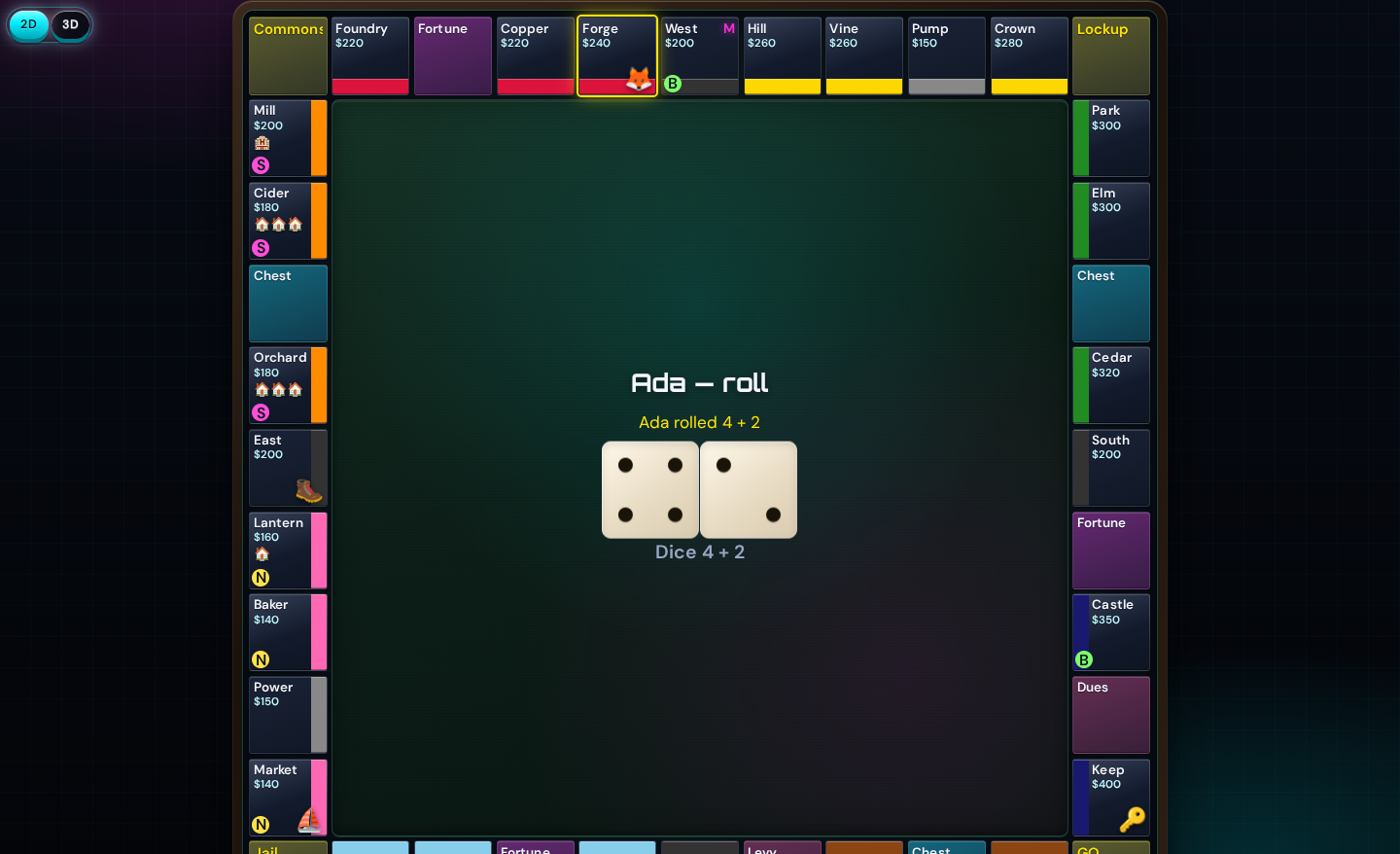
Freehold board in 2D 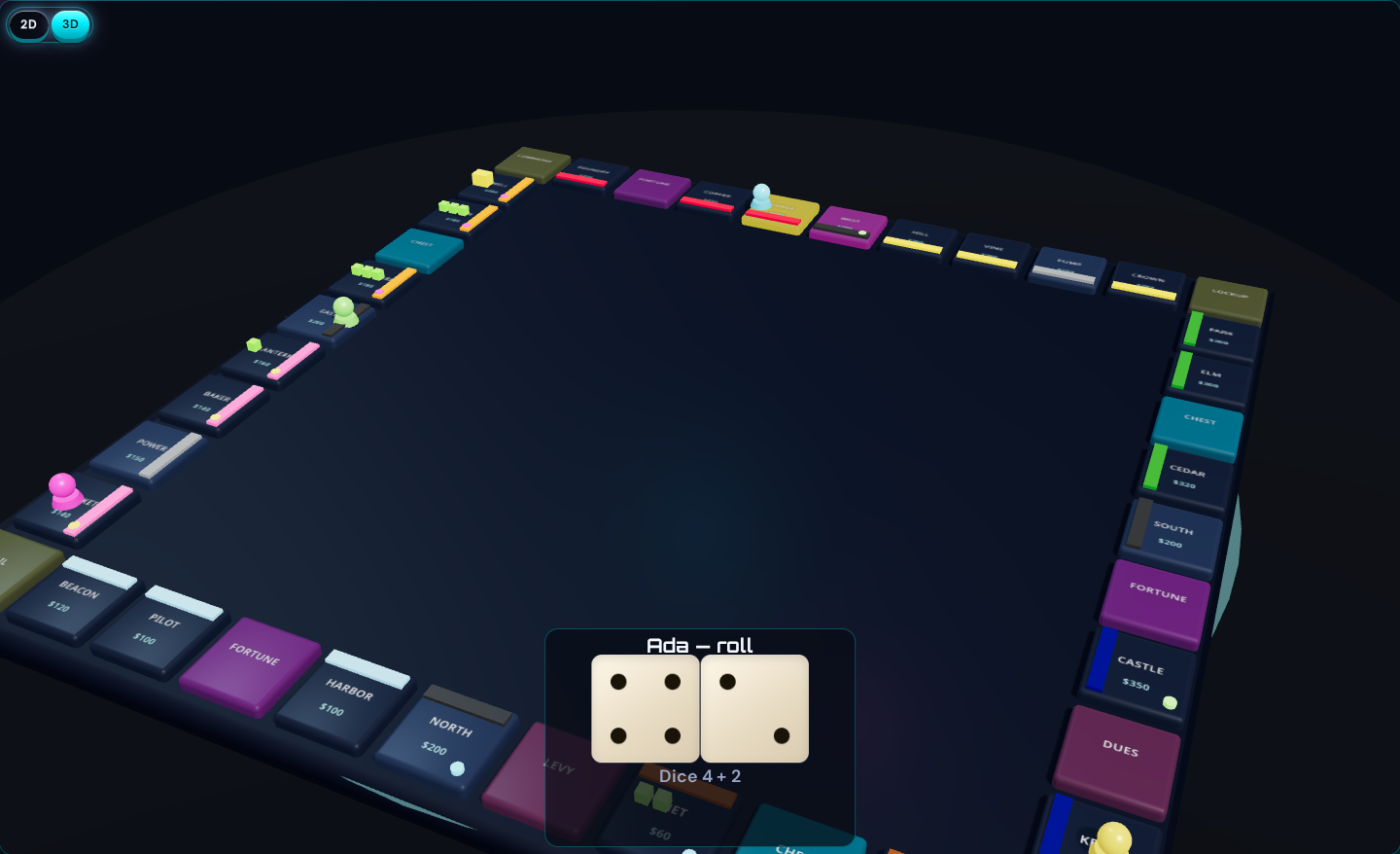
Freehold board in 3D
Money, as the server counts it
Everyone starts with $1,500. Passing GO, or landing on it, pays $200. Town Levy is a flat $200 and Harbor Dues are a flat $100. There is no “pay 10 percent” option. The Commons pays nothing. No pot collects there.
Unowned property can be bought for the printed price. Decline, and it is auctioned. The phone offers the minimum raise, then $9 more and $49 more when you can afford them. Pass drops you out. The last bidder pays and takes the deed. If everyone passes, the space stays unsold. Tokens are shuffled from fox, boat, key, lamp, boot, cart, crown, and star.
Rent, houses, and the bank’s limits
Rent on a street is the printed amount for the buildings on it. A complete color group with no houses charges double the base rent. You cannot build until you own every street in the group, and you cannot build if any street in that group is mortgaged. Houses must stay even: you add a house to a street that currently has the fewest. A hotel is the fifth building. The bank holds 32 houses and 12 hotels. When they are gone, nobody builds that piece until someone sells one back.
Selling a building returns half the build cost to you, and you must sell from the street that has the most buildings in the group. A hotel can be sold only when the bank has four houses to put back on the street. Mortgaging a street with no buildings pays the mortgage value printed for that space. Unmortgaging costs the mortgage plus ten percent, rounded up. You cannot mortgage or trade any street in a color group while any street in that group still has buildings. Sell them first, evenly.
Railroads rent at $25, $50, $100, or $200 for one through four owned and unmortgaged. Utilities rent at four times the dice if you own one, and ten times the dice if you own both. A mortgaged railroad or utility does not count toward that. A Fortune card that sends you to a utility rolls the dice again and charges ten times that roll when the utility is owned.
Jail, doubles, and going broke
Doubles give you another roll after you finish the turn’s business: build, mortgage, or trade, then roll again. Three doubles in one turn send you to jail, and that third double does not move you around the board. In jail you may pay $50, play a jail pass, or try to roll doubles. A double gets you out and you move that amount, but it does not grant yet another roll. Fail three times and you pay the $50 — raising cash first if you must — and then move by that roll. A pass goes back to the deck it came from. Cards can also jail you, pay you, move you, or bill repairs. A card that collects from every player makes a short player raise funds or go bankrupt to the collector. A card that pays every player delivers the money to them, even if you had to mortgage first.
If you cannot pay rent, tax, or a fine, mortgage and sell buildings from the phone, or declare bankruptcy. Bankruptcy removes you and your deeds. The game ends when one solvent player remains. There is no “richest after one hour” score. If the room must stop, agree that out loud. The server will keep going.
Trades are cash, deeds, and jail passes, offered from your phone to one other player during your management phase. The offer is spelled out on their phone and summarized on the television. They accept or decline on their phone. On a shared phone, the seat that must bid or answer the trade is the one whose buttons show.
Hosting it so the night survives
A friend elsewhere can open the board and the controls on one device and share the room code. Talk through the deals on a call. The dice will wait.
- Put a clock in the room that is not the game. Two hours is a full session for four people. Eight people need a stated stopping time.
- Practice the QR join on a shorter game first if anyone is new. Rebuilding a Freehold room mid-board throws away every deed.
- Keep trades spoken. The phone UI will let you send an offer the rest of the couch cannot see.
- Build houses as soon as a set is complete and unmortgaged. Rent without houses is how a lead evaporates.
- Do not wait for Free Parking to save you. It pays nothing.
FAQ
Is this Monopoly?
- No. Freehold is an independent CastPlayTV game and is not affiliated with Hasbro. It plays as a property-trading board for 2–8 people, with rules implemented in this codebase and described on this page.
How does an auction work?
- If you decline to buy an unowned street, railroad, or utility, the other solvent players bid from their phones. Each bid is the current high plus $1, plus $10, or plus $50, offered as those three buttons. Pass to drop out. The last bidder pays and receives the deed.
What does Free Parking pay?
- Nothing. No fines are stored there. Landing on it simply continues the turn.
Can I build houses unevenly?
- No. You may only add a house to a street that has the fewest in its color group, and only when you own the whole group and nothing in it is mortgaged. Selling removes a house from a street that has the most.
Where do trades happen?
- On the two phones involved, during the player’s management phase. The shared screen keeps the board. Cash, deeds, and Get Out of Jail Free cards can be offered. Streets with buildings cannot be traded until the buildings are sold.