
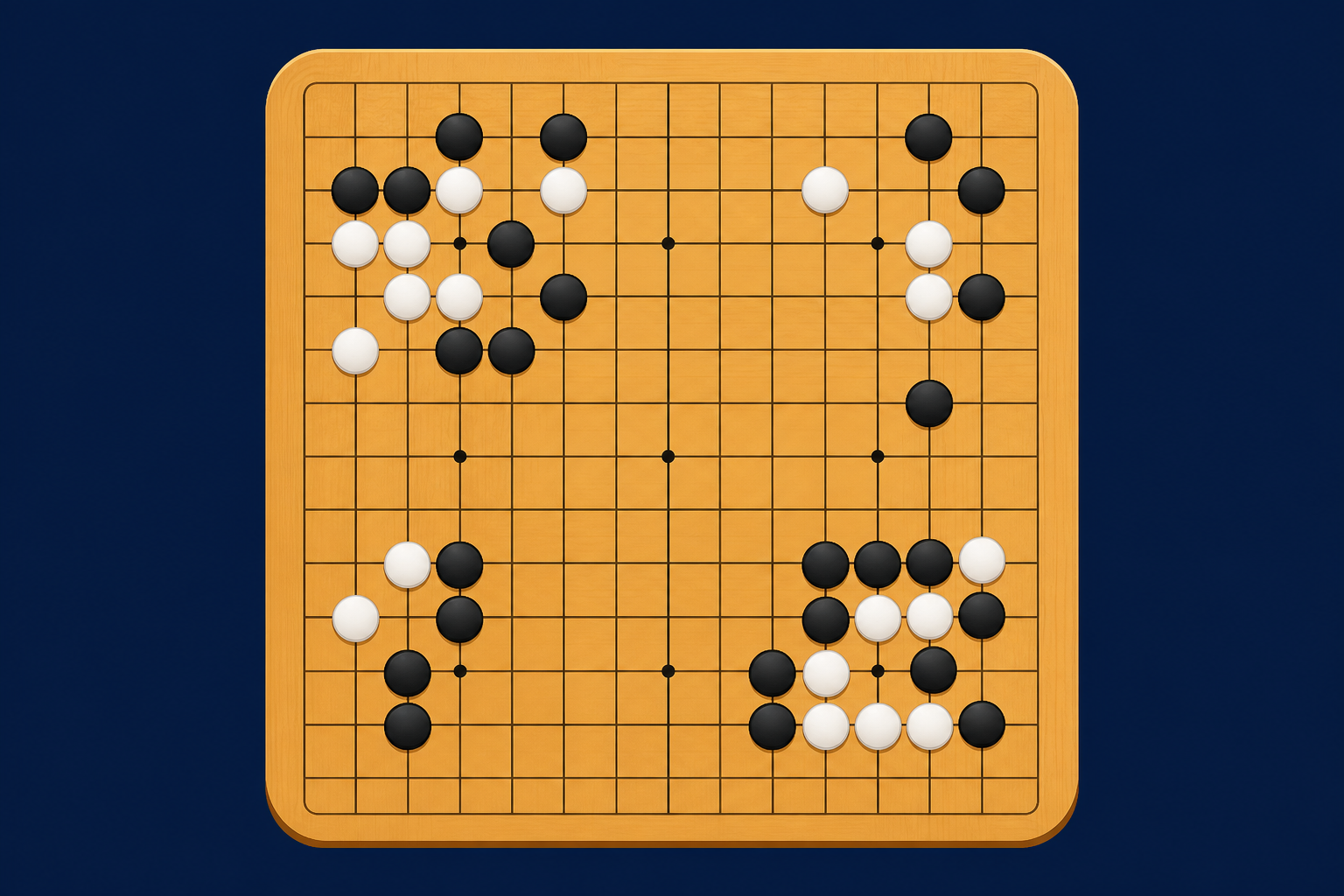
Go on a 3D board, with the size chosen before the first stone
Go 3D is the stone-placing game, not a chess variant with a new skin. Two players take turns putting a stone on an intersection. Surround a group and it comes off. The television shows a 3D board. The phone shows a flat board you can actually tap. Before anyone plays, the host picks 9×9, 13×13, or 19×19. That choice matters more than the camera angle. Add computer in the lobby seats an opponent at Easy, Normal, or Hard, so you can play the 3D board against the computer.
2 players
Try it now
Place stones on a 9×9, 13×13, or 19×19 board without setting up a room. The computer plays a beginner style: it takes captures, avoids filling its own eyes, and answers nearby. Two passes score with Chinese rules and komi. Pass-and-play works on one screen too.
How to play
1Go 3D
Classic Go on a 3D table — surround territory, capture stones.
Play on TV or with Player with own screen on phone, tablet, or computer.
Pick the board for the people in the room
A 19×19 game is the full board and it can sit there all evening. A 9×9 game finishes while the tea is still warm, which is the right size when one person is learning what a liberty is. 13×13 sits in between. The host sets the size in the lobby. You cannot change it after the first stone without starting again. Black plays first. The two seats are the only seats. Watchers stay on the shared screen.
Komi, the points White receives for moving second, depends on the size. On 9×9 White gets 6.5. On 13×13 and 19×19 White gets 7.5. The half point is deliberate: it breaks ties. Say the number out loud when you start, so nobody argues about it at the end.
A turn, and what the server will refuse
On your turn you place one stone on an empty intersection, or you pass. Stones do not move. A connected group of one color lives as long as it has a liberty, an empty intersection next to it, counting only up, down, left, and right. Diagonals do not count. If your stone takes the last liberty of an opposing group, those stones leave the board and add to your capture count. The phone shows captures, and the public state includes them.
Suicide is illegal. If the stone you just played would have no liberties, and it did not capture anything that freed a liberty, the server rejects the tap. Simple ko is also enforced. When a move captures exactly one stone and leaves your new stone with exactly one liberty, the point you just captured is forbidden for the opponent on the next turn. You cannot immediately replay the same capture. There is no superko rule beyond that single forbidden point. If a position repeats in a more complicated way, the server will not stop you.
How a finished board is scored
Two passes in a row end the game. The server then scores Chinese area: each player gets one point per stone still on the board, plus one point per empty intersection that is surrounded only by their color. White then adds komi. The higher total wins. The half-point komi means a true tie on the stones still produces a winner.
Dead stones are not removed for you. A group that both players know is dead still counts for its owner if it is sitting on the board when the second pass happens. Capture it before you pass, or fill the dame you care about before you pass. There is no separate “mark dead stones” phase. Resign is available if the game is already over in every sense but the score.
Quick play on this page uses those same sizes, the same two-pass ending, and the same komi. The computer plays a beginner style: it takes captures, it tries not to fill its own eyes, and it answers nearby rather than inventing a deep fuseki. You can also pass a single screen back and forth. The 3D table is the room view. This page is the place to learn the click before you invite someone.
A first evening that does not stall
A remote friend can take the board and the controls on one device. Send the room code as text. Go is turn-based, so a short delay is fine.
- Start on 9×9 unless both of you already play. Nineteen lines look impressive and then take ninety minutes of “is this group alive.”
- Name the rule about dead stones before the first pass. The score is the board as it stands.
- Keep the phone board for placing and the TV for arguing about eyes. Tapping a 19×19 grid on a television remote is not the design.
- Pass only when you mean it. One accidental pass is recoverable. Two end the game.
- If you are teaching, let the learner be Black on 9×9. First move, smaller board, and you can talk through a capture without a crowd waiting.
FAQ
Which size should we pick?
- 9×9 for a first game or a short one. 13×13 when you want more fighting and still an end. 19×19 when both players already know they want a full board. The host chooses in the lobby, before the game starts.
What is komi here?
- White receives 6.5 points on 9×9 and 7.5 points on 13×13 and 19×19, added after the stones and surrounded empty points are counted.
Do I have to remove dead stones myself?
- Yes. Scoring counts stones on the board plus empty points surrounded by only one color. A dead group left in place still scores for its owner. Capture it before the second pass.
Can I play a stone with no liberties?
- Only if that stone captures opposing stones and ends up with a liberty. A pure suicide move is rejected. The simple ko point, the single stone you just captured in a one-stone ko, is illegal on the immediate reply.
Can I try Go on this page?
- Yes. Quick play lets you place stones on 9×9, 13×13, or 19×19 against the beginner computer, or pass-and-play. Two passes score the board. Host a room when you want the 3D table with another person.