

Neon Town: roll the loop, buy the star, then the phones play
Neon Town is a party board on a cartoon night street. Two, three, or four people start on the town square with 10 coins. The television shows the table: tiles, pawns, and the star. Phones hold the roll button, the fork choice, the shop, and a short game after every round. Most stars wins. Coins break a tie. A usual night is 12 rounds. The lobby can set 8 or 16 instead, and empty seats can be computers at Easy, Normal, or Hard.
2–4 players
How to play
1Most stars after the rounds
Two to four players start on the town square with 10 coins.
The lobby picks 8, 12, or 16 rounds. Twelve is the usual night.
Most stars wins. Coins break a tie.
2Hold the die, then pick a street
Hold the roll button and let go. You move that many tiles.
At a fork, the phone asks which street to take.
The TV camera eases in on the pawn that is moving.
3Blue pays, red takes, a star costs 20
Blue gives 3 coins. Red takes 3, and coins never go below zero.
Pass the star and you may buy it for 20. It then moves.
A bonus card can give 5 coins, an extra roll, or a swap.
4Two items in your pocket
The shop sells a double die for 5, an exact die for 8, or a trap for 6.
You can hold two. The exact die moves you 1, 2, or 3.
A trap sits on a tile. Whoever else lands there pays you 5.
5A short phone game each round
After everyone has moved, phones play a quiz, a tap race, or a rhythm.
It lasts about twenty seconds. First gets 10, second 5, third 2.
An event tile can nudge the whole table, such as two steps back.
6Last three rounds, then two bonus stars
In the last three rounds, blue and red tiles pay double. A banner says so.
Then one star goes to the most minigame wins, and one to the most coins collected.
The TV shows the podium. Computers can fill empty seats.
Screenshots

Neon Town board on the shared screen 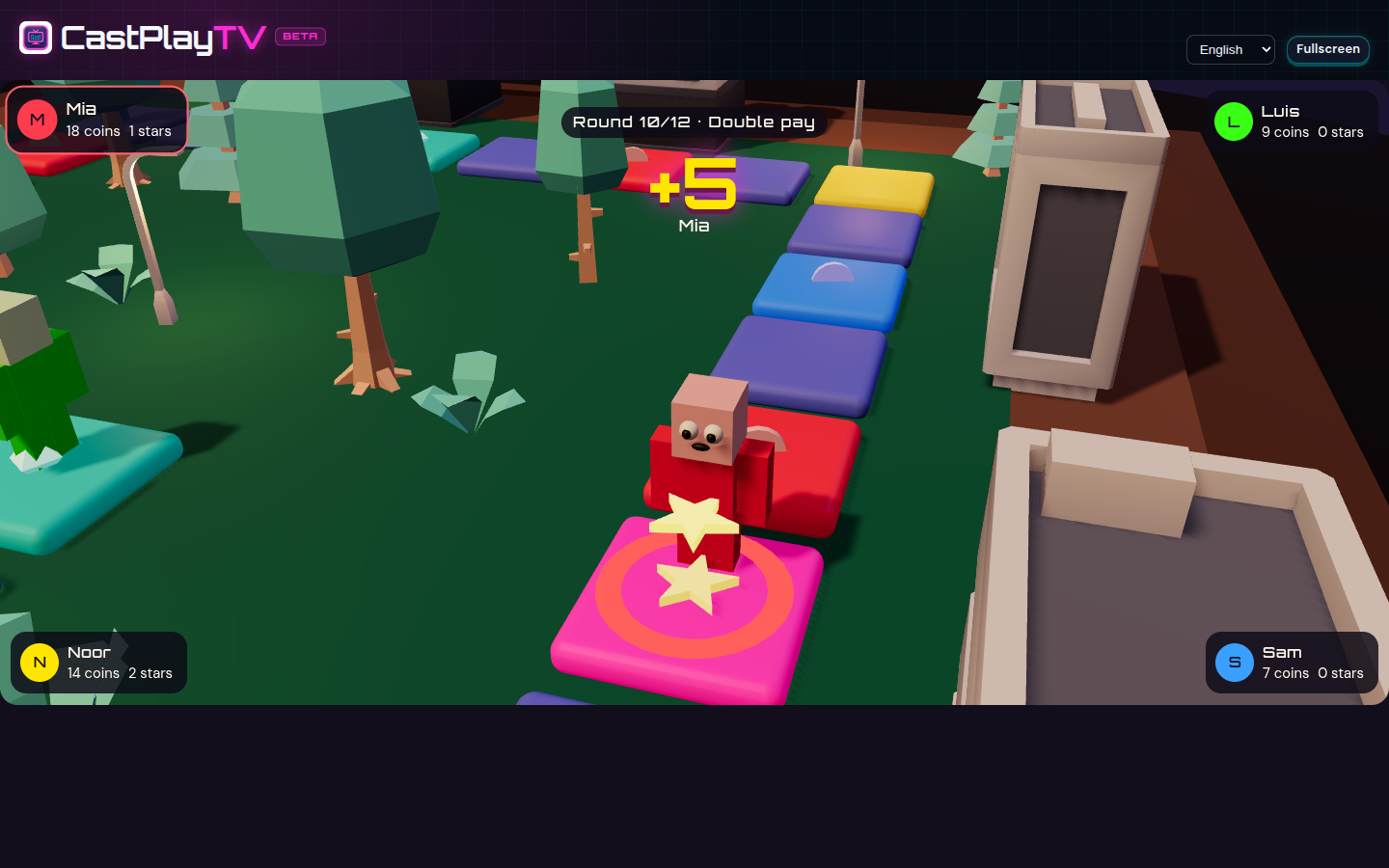
Bonus roll on the phone

Phone controller during a turn 
Choosing the fork
A turn on the loop
Hold the roll button on your phone and let go. You move that many tiles, hopping one square at a time. The camera eases in on the pawn that is moving. Where the street splits, the phone asks which way to go. There are two forks on the board, an alley and a park cut, so a short roll can still change who reaches the star.
Landing on blue pays 3 coins. Landing on red takes 3, and coins never drop below zero. Passing a colored tile does nothing. Only the square you stop on pays. A bonus square draws a card: 5 coins, an extra roll, or a swap with someone you pick. A shop lets you buy one item, then the turn ends. An event square hits the whole table: everyone steps back two tiles, the poorest player gains 5, everyone gains 2, or the richest pays a small toll.
Stars, items, and the last stretch
One star sits on a random tile. When your pawn steps onto it, you may buy it for 20 coins. If you do, it moves somewhere else. If you cannot afford it, you walk on. You can also leave it on purpose. Stars are the score. Coins are how you buy them, and coins are the tiebreak at the end.
You can hold two items. A double die costs 5 and rolls two dice. An exact die costs 8 and moves you 1, 2, or 3, which is how you land on the star when you can count the squares. A trap costs 6. You place it on a tile, and the next other player who lands there pays you 5. In the last three rounds, blue and red pay double, and a banner says so before those rounds begin.
The phone game, then the podium
After every player has taken a turn, the phones play for about twenty seconds. The three games rotate: a three-choice quiz, a fastest-tap mash, and a short rhythm. First place gets 10 coins, second 5, third 2. Ties share the prize for that rank. When the chosen number of rounds is done, two bonus stars are handed out: one to whoever won the most phone games, and one to whoever collected the most coins along the way. Ties on a bonus star each receive it.
The television then shows the podium. A remote player can put the board and the controls on one phone, tablet, or computer. In one living room, keep the table on the TV and use phones as controllers. Several people can share one phone. When someone leaves a seat mid-game, that seat becomes a computer so the night does not stop.
How a short night stays mean
Eight rounds is a warm-up. Sixteen is a full evening. Twelve is the default because the last three doubled rounds still arrive before people check the time.
- Count to the star before you spend the exact die. A roll of 1–3 that lands on it is worth more than a long double.
- A trap a few squares ahead of the leader collects more often than a trap on a square nobody is walking toward.
- Save 20 coins when the star is close. Blue tiles in the last three rounds pay 6, which is the fastest way to rebuild a purse.
- The phone game is part of the score. A quiet quiz still pays 10, and the bonus star at the end remembers who kept winning them.
FAQ
How do you win Neon Town?
- The player with the most stars after the rounds wins. If stars are tied, the higher coin total wins. If those match too, the game is a draw.
How many rounds, and how many players?
- Two to four players. The lobby chooses 8, 12, or 16 rounds. Twelve is the default. Computers can fill seats at Easy, Normal, or Hard.
What does a star cost?
- 20 coins, and only when you step on the tile where it is sitting. After a purchase it moves to a new tile.
What are the items?
- Double die (5 coins, two dice), exact die (8 coins, move 1, 2, or 3), and trap (6 coins, the next other player who lands there pays you 5). You can hold two.
What happens after each round?
- Phones play a quiz, a tap race, or a rhythm for about twenty seconds. Prizes are 10, 5, and 2 coins. In the last three rounds, blue and red tiles pay double.