
Nest Dash: two tokens each, and a six to leave the nest
Nest Dash is the “race your pieces home” game, played on a 3D cross board. Two, three, or four people each have two tokens in a colored nest: red, blue, green, then yellow, in seat order. You roll one die on your phone. The television shows the tokens move. The first person to get both tokens all the way home wins. It is mean in a small way, because landing on someone sends them back to the nest, and it is short enough for people who do not want a two-hour board. The lobby can add computer players at Easy, Normal, or Hard, so you can race the computer when the couch is short a person.
2–4 players
How to play
1Two tokens, your color
Each player has two tokens, waiting in a nest.
Seat order paints them red, blue, green, then yellow.
First to bring both tokens all the way home wins.
2A six leaves the nest
Roll one die on your phone.
A token in the nest moves only on a six, onto your entry square.
Any other roll, with both tokens still nested, passes the turn.
3Sixes give another roll
A six lets you roll again.
That lasts until the third six in a row, which ends the turn.
You do not get a fourth roll.
4Walk the ring
On the ring, move clockwise by the die.
Your color travels 51 steps of the 52-square ring before the home lane.
When both tokens can use the roll, pick one on your phone.
5Land on a rival and they go home
Landing on a square sends every rival token there back to its nest, even two stacked together.
Passing over a square does not.
Your own tokens may share a square. The home lane is safe.
6Finish on an exact roll
The home lane is six squares, then one last exact step off the board.
A roll that would pass the end is illegal for that token.
If the other token can move, you must move it. If neither can, the turn ends.
7The phone rolls, the table shows it
The television shows the board. Your phone has the die and, when you have a choice, the token buttons.
The lobby can add a computer at Easy, Normal, or Hard.
Give up is there if you would rather stop chasing two nested tokens.
Screenshots
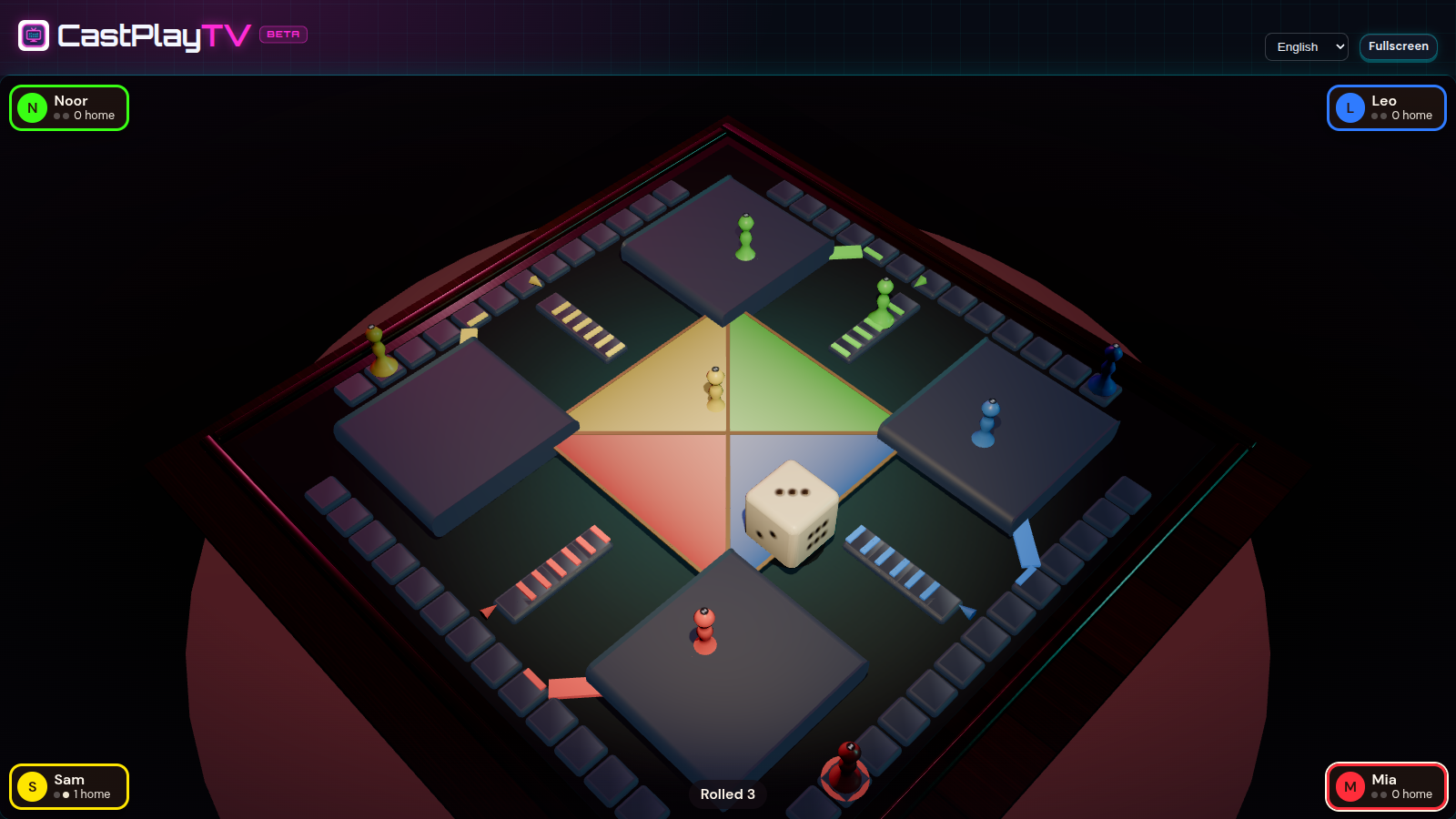
Nest Dash table on the TV 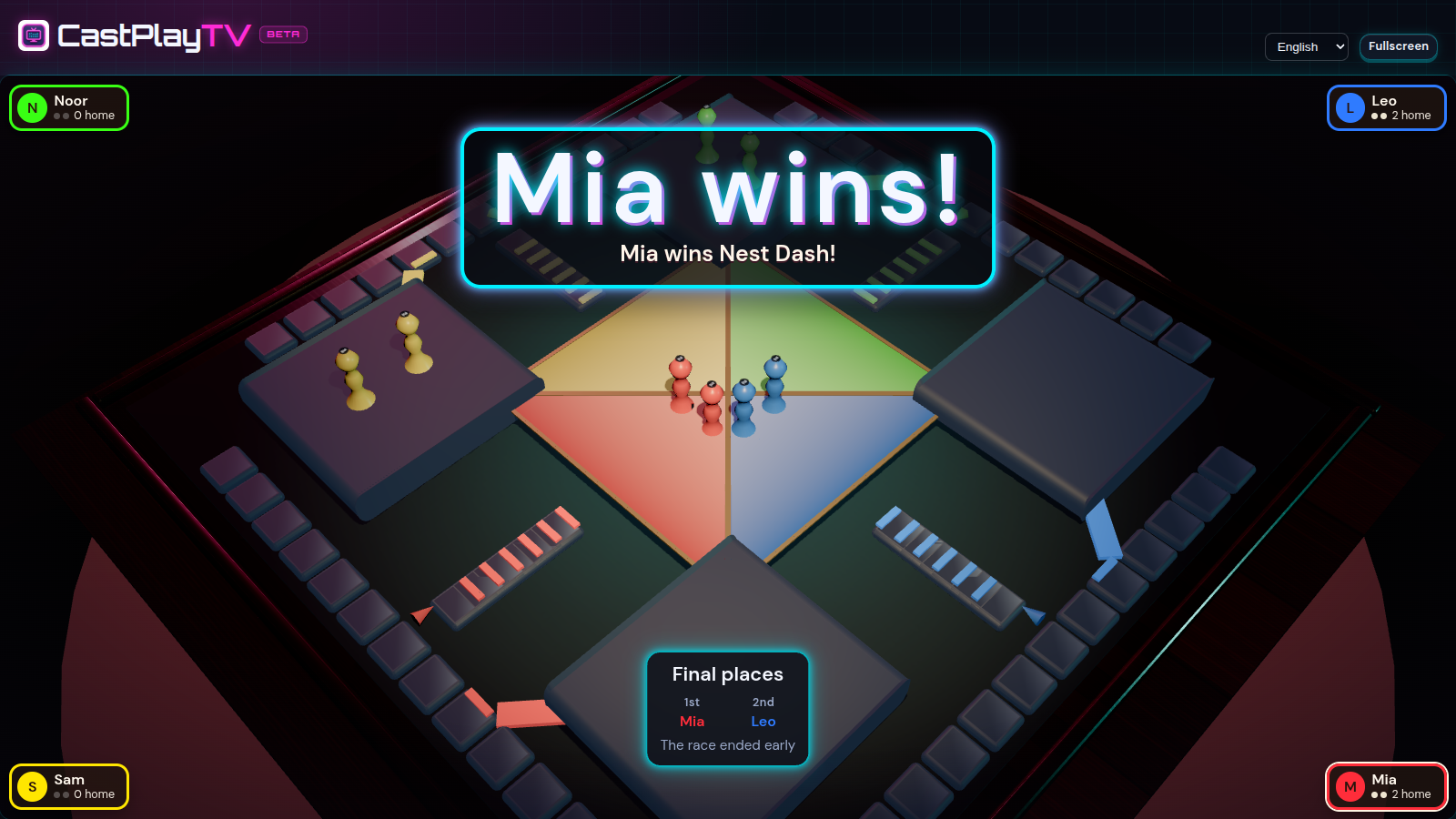
Red wins the race
Leaving the nest
A token in the nest moves only on a six, and that six places it on your entry square of a 52-step ring. Anything else, with both tokens still nested and no six, is a wasted turn: the server will say you cannot move and play passes on. Red enters at one corner of the ring, then blue, green, and yellow around the cross. You do not choose the color. Seat order does.
A six also lets you roll again, up to three sixes in a row. The third six ends the turn instead of giving a fourth roll. The log says so. Plan on the extra roll. Do not plan on a streak.
Bumps, blocks, and the home stretch
Once a token is on the ring it moves clockwise by the die. If it lands on an opponent’s token, that token goes back to its nest. Both of an opponent’s tokens go home if they were stacked on that square. Your own tokens may share a square. The capture only happens on the ring. The colored home path is safe.
Each color travels 51 steps along the ring and then needs an exact roll to enter a home lane of six cells and, finally, an exact roll to step off the last cell into “finished.” Overshooting does not wrap and does not bounce. That token simply is not a legal choice for that roll. If the other token can move, you must move it. If neither can, the turn ends. You pick which token to move on the phone when both are legal. The first player with both tokens finished wins. Resign is there if you would rather not chase two nested tokens for another twenty minutes.
The 3D table and a remote seat
Host the Main screen on the TV. The board is a table, and the tokens read better at a distance than a flat diagram would. Phones only need the roll button and, when you have a choice, the token buttons. If the TV browser drops frames, host from a laptop. The die is a phone tap either way.
Unlike the pure party race, a remote player can put the 3D board and the roll controls on one phone, tablet, or computer. That suits two people in different apartments who still want this ruleset. In one living room, keep the table on the TV. People can each use a phone, and several people can share one. That phone, not the television, has Share this phone in the lobby. Each name is a seat. When the turn moves between seats on that phone, it asks you to pass the phone and tap Ready before the next person sees the roll. The board is not hiding anything. The pause is so everyone knows whose tokens are about to move. A six that earns another roll stays with the same person. The phone changes hands only when the turn does.
How the mean turns actually help
Two players make a duel with long stretches of open ring. Four players make a traffic jam, which is the better party. Three leaves one color unused and is perfectly legal.
- Get one token out before you march the other. A single token near home is a target, and a six you needed for the nest is now a six you must spend on the leader.
- Park on the ring where an opponent must pass. A bump costs them a six later. That is worth more than two steps of progress.
- Do not enter the home lane a roll too early if the other token is still nested and the table is hostile. Exact rolls are scarce. A token stuck one step from finished is safe, and also not scoring the win.
- With four players, expect your lead token to be sent home at least once. The win is both tokens, not the first one to arrive.
- Three sixes feel lucky and then the turn is over. Spend the first two sixes on purpose. The third may never be a move.
FAQ
How do I get a token out?
- Roll a 6. The token enters on your color’s square of the ring. Other rolls do nothing while every token is still in the nest.
What does landing on someone do?
- Their token goes back to the nest, if you landed on it on the shared ring. Tokens on a home lane are not captured. You may stack your own tokens.
Do I need an exact roll to finish?
- Yes. The home lane is six steps, and the last step off the lane onto “finished” also has to be exact. A roll that would pass the end is illegal for that token.
What happens on three sixes?
- Each six lets you roll again, until the third six in a row, which ends the turn. You do not get a fourth roll.
How many tokens, and who wins?
- Two tokens per player, and two to four players. The first player with both tokens finished wins. Colors are red, blue, green, and yellow in seat order.