
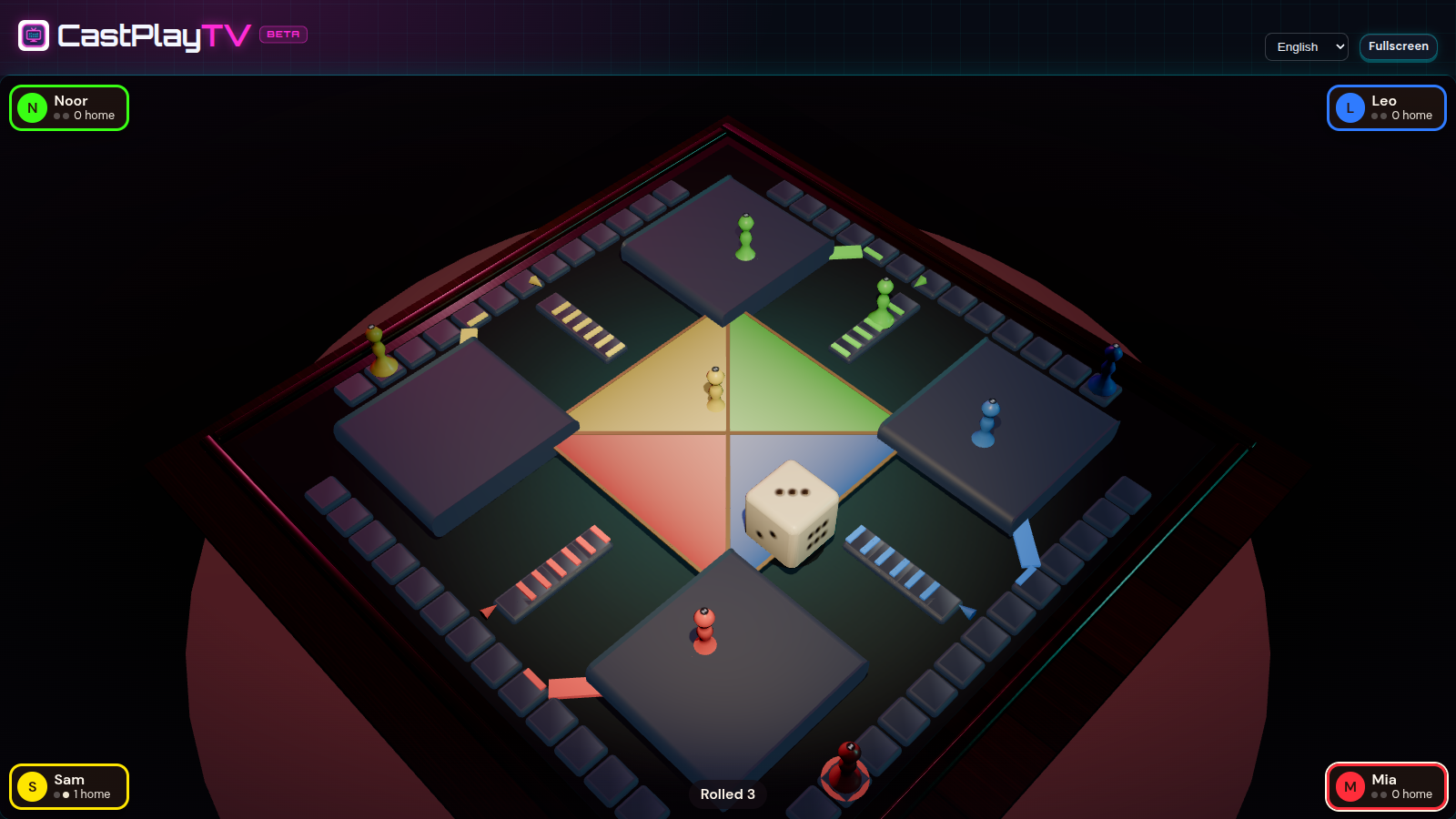
Spend the first sixes on the nest
Both tokens start in the nest. Only a six moves one, onto your entry square. Anything else, with both still nested, passes the turn. Colors are red, blue, green, then yellow, in seat order, thirteen squares apart. You do not pick the color. Red rolls first.
A six lets you roll again, up to three in a row. The third six can still be a move if a token can use it. It does not earn a fourth roll. Spend the first six leaving the nest. If the extra roll is another six, bring the partner out before you march. One token on the ring must take every roll that is not a six, so it walks alone. Two tokens on the ring give you a choice later. If the extra roll is a one through five, you have to move the token that just entered. The next six is for the partner, unless it lands on a rival.
A bump is worth more than a sprint
You capture only by stopping on a rival. Passing over a square does nothing. Two stacked rival tokens on that square both go back to the nest. Your own tokens may share a square. The home lane is safe, and so is a finished token. Entry squares are ordinary ring squares, so they can be captured too. Standing on an opponent’s entry is a gift: their six out of the nest lands on you, they come out, and you go home.
The stop that matters is one to six squares ahead of a chaser. That is the only window one die can hit, and farther back cannot reach you this turn. Hard computer players already avoid that window. Stacking your own pair on the ring doubles the loss, because one landing sends both tokens home and each needs a new six. When the phone asks you to pick a token, take the capture first, then the token sitting in someone’s reach, then plain progress. Do not sprint a lone token while a six would have brought its partner out.
The home lane only takes an exact roll
Each color travels 51 steps of the 52-square ring, then needs an exact roll to enter a home lane of six cells, and another exact roll to step off the last cell into finished. Too far does not wrap and does not bounce. That token cannot take the roll. If the other token can move, you must move it. If neither can, the turn ends. A six you cannot spend still grants another roll, until it is the third six in a row.
From the last ring square, a one enters the first home cell, which later needs a six to finish. A six from that same square lands on the last home cell, which later needs a one. Six squares further back, only a six reaches the lane, and it stops on the first cell. A token there ignores every roll except a six. Those other rolls move the partner if the partner is on the ring. They move nothing if the partner is still nested. Enter the lane, because nothing on it can be bumped. Do not spend your only six on that first cell while the other token has not come out.
The first player with both tokens finished wins. With three or four players, if others are still racing, a phone asks whether to play on for the other places or end the game. First place is already set. Two players skip that question, and the other seat keeps rolling. Resign is there if you would rather stop chasing two nested tokens.
Two players and four players are different races
Two players leave a long open ring. Bumps are rare, and each one swings the race, because a nested token needs a six and only one opponent is hunting. Get the second token out. Do not trade your only developed token for a token they can spare.
Three players is a full game, and yellow is unused. Four players put an entry every thirteen squares, so someone is usually within a die of you. Expect the lead token to be sent home at least once. Keep one token in the lane, where it is safe, and use the other to bump. Both tokens have to finish. The first one into the lane is only halfway there. Red’s opening roll is a small edge. Sit in the order you want before the host starts if that first roll matters.
Practice on Easy, Normal, and Hard
Add a computer in the lobby at Easy, Normal, or Hard when the couch is short a person, or before guests arrive. The die, the captures, and the exact finishes stay the same. The Nest Dash game page is the short rules if someone at the table has not played.
Easy picks a legal token at random. Use it to learn Roll Die and the token buttons, and to see what an overshoot does, without being hunted for every stop. Normal prefers leaving the nest, capturing, and moving toward home, and it will sometimes take a slightly worse token. Hard does that and also avoids stopping one to six squares in front of a rival. Play a few games on Hard before a four-player night. Empty seats can be computers, so two people can still practice a crowded ring.
Host the table, then decide who needs their own screen
Put Main screen on the TV so the room watches the 3D table. Phones roll, and they pick the token when both can move. Look at the phone when it asks. If the TV browser drops frames, host from a laptop over HDMI. How to Host a TV Game Night covers the room. QR Code Join Troubleshooting covers a scan that will not take.
Phones paired to that TV stay paired for the night and take a seat when the next lobby opens, if there is room. Nest Dash seats two to four. A fifth phone can wait for the next game, or leave. Share this phone is a control on the player phone. Each name is a seat. Pass the phone and tap Ready when the turn changes names. A six that earns another roll stays with the same person, so do not hand the phone over mid-streak.
Player with own screen puts the board and the roll on one phone, tablet, or computer. Use it for someone who is not on the couch. Play Online with Player with Own Screen is the setup, and the room code is what you send. In one living room, leave the table on the TV. A remote friend can use their own screen while the couch still watches the set.
What to open next
A rematch needs no new scan if the phones are still paired to the TV. Cast Dash is the other race, for two to six, when the table wants a shorter party board instead of exact rolls. DoodleDash fits between races. WordGrid is the quieter shared board when the room has had enough dice.
Nest Dash
Two to four players race two tokens home on a 3D board. A six leaves the nest. Land on a rival and they go back.
2–4 players
Cast Dash
A 30-tile party race for 2–6, with power-up cards, trivia, and a five-second tap contest.
2–6 players
DoodleDash
Draw on a phone, guess out loud. Two to eight players, English or Swedish words, 75 seconds a turn.
2–8 players
WordGrid
A 15×15 tile crossword for 2–4. The grid is shared. Each rack stays on that player’s phone.
2–4 players

FAQ
How do I get a token out of the nest in Nest Dash?
Roll a six. The token enters on your color’s square of the ring. Any other roll does nothing while both tokens are still nested, and the turn passes.
What happens on the third six in a row?
You may move with that six if a token can legally use it. The turn then ends. You do not get a fourth roll.
Do I bounce if I roll too high near home?
No. A roll that would pass the end is illegal for that token. If your other token can move, you must move it. If neither can, the turn ends.
Is it safe to stack my two tokens?
On the home lane, yes. On the ring, a rival who lands on that square sends both tokens back to the nest. Passing over them does not.
Can we play Nest Dash on one shared phone?
Yes. Use Share this phone in the lobby, one name per seat. Pass the phone and tap Ready when the turn changes. A bonus roll from a six stays with the same person.
Do Easy, Normal, and Hard computers play by different rules?
No. They use the same die, captures, and exact finishes. Easy picks a legal token at random. Hard also avoids stopping where a rival can land on the next roll.
More guides
Browse the guides library, or jump to hosting a TV game night, QR join troubleshooting, or Player with own screen.